


Key takeaways
- Isolated margin caps a position's risk at the amount allocated to it.
- Cross margin uses your available balance as shared collateral across multiple positions.
- Unified margin on Neverless simplifies collateral management across different assets and products.
- The right choice depends on your strategy, your risk tolerance and how much flexibility you need.
On most platforms, you have to choose a margin mode before you can even open a leveraged position. Many traders tick a box without a second thought. Yet that choice decides what you stand to lose on the day the market turns against you: a single position, or your entire account.
Isolated margin or cross margin? Both have real advantages and very specific risks. Here's how each one works, with worked examples, so you can make an informed choice.
Margin trading: a 2-minute refresher
Margin trading means borrowing to invest more than you actually own. Your assets act as security for the loan: this is your collateral. The ratio between the size of your position and your own capital is your leverage.
Say you have €5,000 and Bitcoin rises 20%. Without leverage, you end up with €6,000, a 20% gain. With 5x leverage, you control a €25,000 position (€5,000 of your own, €20,000 borrowed). The position gains €5,000: once the loan is repaid, you're left with €10,000, a 100% return.
The reverse is just as true. If Bitcoin falls 20%, the position loses €5,000 and your capital is wiped out entirely. Leverage amplifies gains and losses alike.
| Leverage | Your capital | Position size | Drop that wipes out your capital |
|---|---|---|---|
| 2x | €1,000 | €2,000 | 50% |
| 5x | €1,000 | €5,000 | 20% |
| 10x | €1,000 | €10,000 | 10% |
| 25x | €1,000 | €25,000 | 4% |
Simplified examples, excluding fees and borrowing interest.
In practice, the platform doesn't wait for your capital to hit zero. It sets a maintenance margin: a minimum level of collateral you must keep. If your collateral falls below it, the position is forcibly closed. This is called liquidation.
So the real question is: which collateral backs which position? That's exactly what your margin mode decides.
Isolated margin: every position in its own silo
Isolated margin means you decide exactly how much collateral backs a position. Only that amount is at risk. The rest of your account can't be used to rescue the position, and it can't be dragged down with it either.
Example. You have €10,000 in your account. You allocate €2,000 of isolated margin to a long position on Ether at 5x leverage, giving you a €10,000 position.
- Ether rises 15%: the position gains €1,500, which is added to your €2,000.
- Ether falls 20%: the €2,000 is lost (liquidation actually kicks in slightly earlier, at the maintenance margin level). The remaining €8,000 is untouched.
You know your worst-case scenario the moment you open the position: €2,000. That's the whole point of isolated margin.
Advantages of isolated margin
- Maximum loss known upfront: you can never lose more than the margin you've allocated.
- No domino effect: one liquidated position doesn't drag the others down with it.
- Easy to follow: each position has its own liquidation price and its own P&L.
- Ideal for testing an idea, a highly volatile asset or high leverage.
Disadvantages of isolated margin
- Faster liquidation: the position can only rely on its own margin, even if your account has cash to spare.
- Manual monitoring: to avoid liquidation, you have to top up the margin yourself, and in time.
- Fragmented capital: money locked into one position can't support the others.
- More limited leverage: your collateral is limited to the margin allocated to the position and doesn't take the rest of your portfolio into account.
- No offsetting: gains on one position can't cushion losses on another.
Cross margin: one shared pool behind every position
Cross margin means your entire available balance backs all of your positions. Unrealised gains on one position support the ones that are losing. Liquidation is no longer assessed position by position, but on the health of the account as a whole.
Example. Same €10,000 account. You open a long position on Ether and a short position on Bitcoin, both at 2x leverage.
- Ether falls, but so does Bitcoin: your short makes money and offsets the loss on Ether. Both positions stay open.
- Ether falls and Bitcoin rises: both positions lose at the same time. If the combined losses eat through your account's margin, everything is liquidated in one go. It's no longer €2,000 on the line, but the full €10,000.
Advantages of cross margin
- More room before liquidation: a struggling position can draw on the whole account, not just a small allocation.
- Automatic offsetting: gains on one position cover losses on another, which makes it ideal for hedging strategies.
- More efficient use of capital: the same euro of collateral supports several positions, so nothing sits idle.
- Higher leverage capacity: your whole portfolio serves as collateral, so the same capital gives you access to more exposure.
- Simpler management: just one margin level to watch, with no need to top up each position individually.
Disadvantages of cross margin
- Your whole account is exposed: in a violent market move, your loss can exceed what you intended to risk on a single position.
- Cascade risk: if several correlated positions fall together, they can all be liquidated at once.
- Temptation to over-leverage: with your whole balance as collateral, it's easy to open bigger positions than you planned.
- Collateral risk hits the whole account: if the asset you use as collateral loses value, your entire account is weakened.
Cross margin vs isolated margin: side-by-side comparison
| Criterion | Isolated margin | Cross margin |
|---|---|---|
| Collateral | Dedicated to each position | Shared across all positions |
| Maximum loss | The allocated margin | Potentially the entire account |
| Distance to liquidation | Shorter | Longer |
| Offsetting gains and losses | No | Yes, automatic |
| Capital efficiency | Lower | Higher |
| Monitoring required | Position by position | A single margin level |
| Risk of cascading liquidations | No | Yes |
Same crash, two outcomes
To really see the difference, let's put both modes through the same shocks. Take a €10,000 account with two long positions of €10,000 each, one on Bitcoin and one on Ether. With isolated margin, each position gets €2,500 (4x leverage) and €5,000 stays free. With cross margin, the full €10,000 backs both positions.
| Scenario | Isolated margin | Cross margin |
|---|---|---|
| BTC -10%, ETH -30% | ETH liquidated, BTC still open. Balance: €6,500 | No liquidation, both positions stay open. Balance: €6,000 |
| BTC and ETH -30% | Both positions liquidated. Balance: €5,000 | No liquidation. Balance: €4,000, positions still open |
| BTC and ETH -50% | Both positions liquidated. Balance: €5,000 | Entire account liquidated. Balance: €0 |
Simplified calculation: excluding fees and interest, maintenance margin ignored.
The lesson is simple. Cross margin absorbs everyday market swings better and gives your positions time to recover. Isolated margin loses a position sooner, but puts a ceiling on the worst case.
Which margin mode suits which situation?
| Situation | Best fit | Why |
|---|---|---|
| Testing a new asset or strategy | Isolated | Your loss is capped from the outset |
| High leverage on a highly volatile asset | Isolated | A sharp move won't affect the rest of your account |
| Hedged strategy (long on one side, short on the other) | Cross | The two legs offset each other automatically |
| Borrowing a little against a diversified portfolio | Cross | Your whole portfolio supports the loan, so liquidation is a long way off |
| Several unrelated, unhedged bets | Isolated | Stops one losing bet from taking down the others |
Isolated margin protects your account from a bad position. Cross margin protects your positions from a bad moment. The right choice depends on what you fear most.
Case study: the 10 October 2025 crash
The risk of cross margin is anything but theoretical. On 10 October 2025, Donald Trump's announcement of a 100% tariff on Chinese imports triggered a massive sell-off across markets.
In the space of 24 hours, a record $19 billion in leveraged positions was liquidated (CoinDesk Research). Bitcoin fell to $106,560, and the tokens tracked by CoinDesk lost around 47% on average.
On Binance, the stablecoin USDe dropped as low as $0.65. The problem: it was being used as shared collateral in many accounts. Its collapse eroded the collateral behind Bitcoin and Ether positions that, taken on their own, were holding up just fine. CoinDesk says shared-collateral mechanisms acted as "accelerants" of the cascade.
Two lessons for any investor using leverage:
- Check the quality of your collateral, not just your positions. Collateral that can suddenly lose its value weakens your entire account.
- Your leverage level matters more than your margin mode. At 20x, a 5% drop is enough to wipe out your capital. At 5x, it takes a 20% drop.
Why Neverless chose unified margin
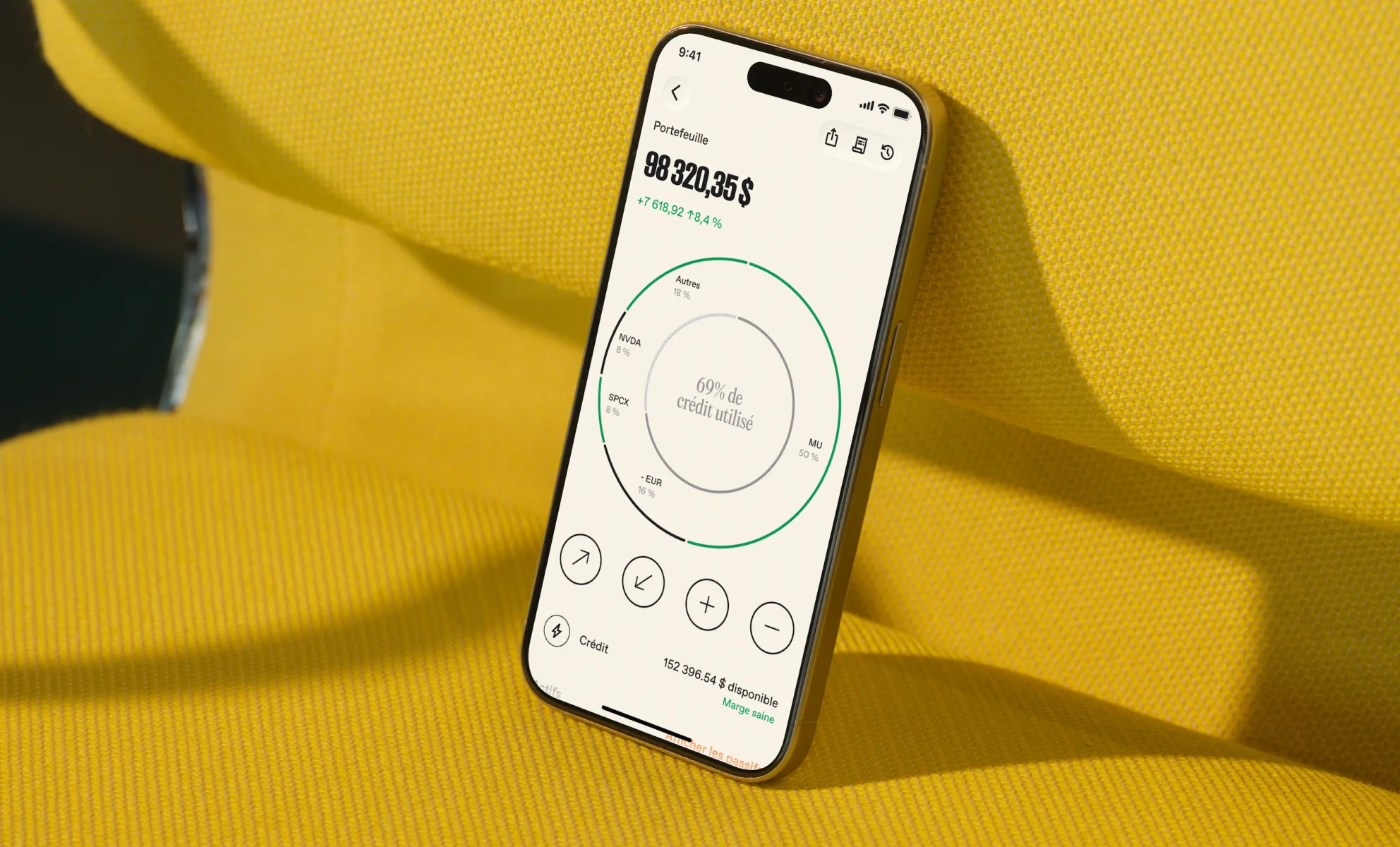
On Neverless, you can trade with up to 5x leverage, borrowing against all the assets in your portfolio, not just one (neverless.com). This is unified margin: the whole-account version of cross margin. We made this choice for four reasons.
- Our users are investors, not scalpers. They hold a diversified portfolio and want to get a little more out of it. With unified margin, that entire portfolio backs the loan: liquidation is pushed further away, and a temporary dip in one asset doesn't close the position.
- Your assets keep working. Assets pledged as collateral keep earning you yield while they back your loan. No capital sits idle, locked away in a separate pot.
- One number to track. No margin to split up or top up position by position. You keep an eye on the health of your account, and that's it.
- Cross-margin risk is kept in check by the leverage cap. The real danger of shared margin is excessive leverage. Where some platforms offer 50x or even 125x, Neverless caps leverage at 5x. At that level, it takes a drop of around 20% across your entire portfolio to wipe out your capital, compared with just 1% at 100x.
In short: unified margin is designed for borrowing smartly against your wealth, not for stacking high-leverage bets. And Neverless operates within the European regulatory framework: Neverless SIA is authorised by the Bank of Latvia as a crypto-asset service provider (CASP) under MiCA, and Boku Securities SIA holds a MiFID II licence.
Leveraged trading involves a risk of capital loss. This article is for educational purposes only and does not constitute investment advice.
FAQ: cross margin vs isolated margin
What is the difference between cross margin and isolated margin?
With isolated margin, each position has its own collateral: you can only lose the amount allocated to that position. With cross margin, your entire account balance backs all of your positions: liquidation is further away, but the whole account is exposed if the market falls sharply.
Which margin mode is best for beginners?
Isolated margin is the easiest to understand when you're starting out, because your maximum loss is known in advance. Cross margin can also suit a beginner who borrows a small amount against a diversified portfolio, as long as leverage stays low. Either way, your leverage level matters more than your margin mode.
Can you lose more than your initial margin with cross margin?
You can lose more than you intended to commit to a single position, since your entire account balance serves as collateral. On most platforms, however, automatic liquidation prevents your balance from going negative, except in extreme and very fast market moves.
What is unified margin?
Unified margin is a form of cross margin extended to your entire account: all of your assets, not just your cash, serve as collateral for your loan. It's the model Neverless uses, with leverage capped at 5x.
What is maintenance margin?
It's the minimum level of collateral you need to keep a position open. If your collateral falls below this threshold, the platform forcibly closes the position: this is liquidation. With isolated margin, the threshold applies to each position; with cross margin, it applies to the whole account.
How can you avoid liquidation?
Keep your leverage moderate, set a stop-loss that triggers before your liquidation price is reached, and keep an eye on the quality of your collateral. With isolated margin, top up the margin in time on a position that's struggling. With cross margin, avoid stacking highly correlated positions.
Is cross margin riskier than isolated margin?
Not necessarily. Cross margin holds up better in moderate downturns, because the whole account supports each position. It is riskier in a market-wide crash or with high leverage, because it can wipe out everything. Isolated margin loses a position faster, but limits your total loss.
Sources
- CoinDesk Research : The $19 Billion Liquidation That Shook Crypto
- Neverless : homepage (5x leverage, yield on collateral, licences)
- Further reading: Binance Academy, Journal du Coin, dYdX, MetaMask (structure and angles)